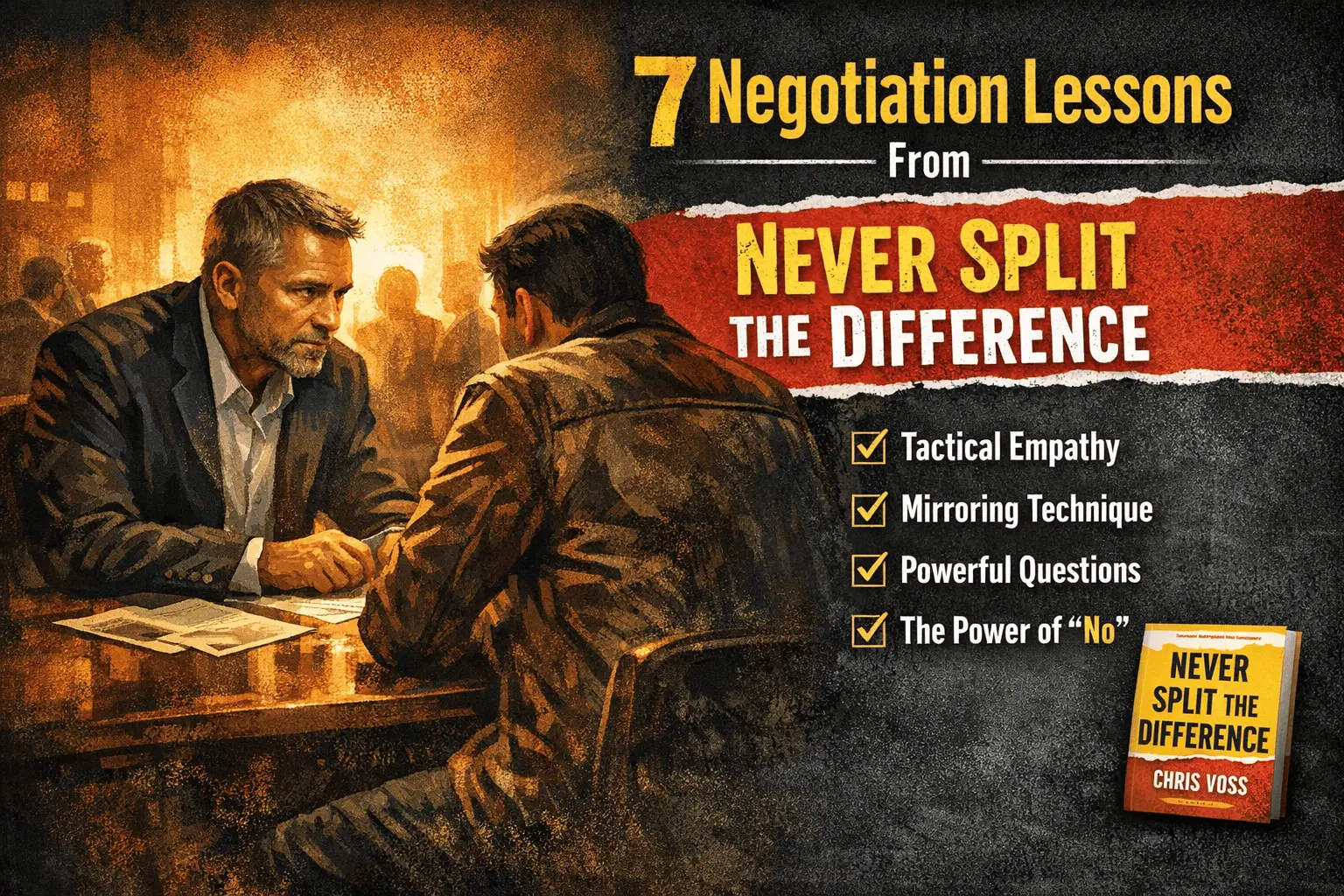
An FBI hostage negotiator once used a simple question to stop a dangerous criminal. That same technique can help you negotiate your salary, close deals, and win difficult conversations. In Never Split the Difference, Chris Voss reveals the negotiation tactics he used in life-or-death situations.
Negotiation is part of everyday life. Whether you're discussing salary, closing a business deal, or resolving a conflict, your ability to negotiate can determine your success. In Never Split the Difference, former FBI hostage negotiator Chris Voss reveals powerful techniques used in high-stakes negotiations.
In this article, we'll explore some of the most powerful lessons from the book and how you can apply them in real life.
Lesson 1: Never Accept the Middle Ground
Many people believe compromise is the best solution.
However, Chris Voss argues that splitting the difference often leads to bad deals.
Example:
If someone asks $100 and you offer $50, splitting the difference at $75 may still be a bad deal for you.
Good negotiators aim for creative solutions, not just compromise.
Lesson 2: Use Tactical Empathy
One of the most powerful concepts in the book is tactical empathy.
This means:
-
understanding the other person's emotions
-
acknowledging their perspective
-
making them feel heard
When people feel understood, they become more cooperative in negotiations.
Lesson 3: The Power of Mirroring
Mirroring is a simple but powerful technique.
It involves repeating the last 2–3 words someone says.
Example:
Person: “The price is too high.”
You: “Too high?”
This encourages the other person to keep talking and reveal more information.
Lesson 4: Ask Calibrated Questions
Instead of asking yes/no questions, ask questions like:
-
“How can we solve this problem?”
-
“What would make this work for you?”
-
“How am I supposed to do that?”
These questions make the other person work with you to find a solution.
Lesson 5: Let the Other Person Say “No”
Most people try to force a yes.
But Chris Voss explains that “No” makes people feel safe and in control.
Example:
Instead of asking:
“Is now a good time to talk?”
Ask:
“Is now a bad time to talk?”
You’re more likely to get a real conversation.
How to Apply These Techniques in Real Life
You can use these strategies in:
💼 Business negotiations
💰 Salary discussions
🏠 Buying a house
🤝 Conflict resolution
📈 Sales conversations
These methods work because they focus on human psychology and emotions.
Conclusion
Never Split the Difference by Chris Voss shows that negotiation is not about winning arguments—it's about understanding people.
By using techniques like:
-
tactical empathy
-
mirroring
-
calibrated questions
you can dramatically improve your communication and negotiation skills.

.webp)