I’ll be honest—when I first signed up for the PMI-ACP exam, I felt confident… for about five minutes.
Then reality hit.
There were frameworks. Principles. Mindsets. Acronyms that looked like alphabet soup. And somehow, I had only 30 days to pull it all together. No pressure, right?
But here’s the twist—I didn’t use ten different resources. I stuck to one solid PMI-ACP exam prep PDF. That’s it. And somehow, it worked.
Let me set the scene. It was a Sunday afternoon in late February — the kind of grey, bone-cold day that makes you want to watch hockey reruns and eat poutine until you feel something again. Instead, I was sitting at my kitchen table in Ottawa with a printed copy of the PMI-ACP Exam Content Outline, a cold coffee, and a growing sense of dread. My exam was booked. Thirty days out. And I'd barely cracked the prep material.
Sound familiar? Maybe you're there right now. Maybe you've been "about to start studying" for three weeks. Either way — I've got you.
What I'm sharing here isn't theory. It's the actual system I built around the PMI-ACP Exam Prep PDF that got me to a passing score in exactly 30 days. Not 90. Not 6 months. Thirty.
Why the PDF Actually Matters (More Than You Think)
First, a reality check. There are a lot of prep resources out there — courses, flashcard apps, YouTube lectures, online mock exams. They're all useful. But the PMI-ACP Exam Prep PDF is the backbone. It maps directly to the seven domains tested on the real exam: Agile Principles, Value-Driven Delivery, Stakeholder Engagement, Team Performance, Adaptive Planning, Problem Detection and Resolution, and Continuous Improvement.
Everything else is noise until you understand how those domains are weighted. The PDF tells you exactly that. It's not glamorous. It's not a slick app. But it's the blueprint.
"Studying without the ECO is like building a house without blueprints. You'll put walls up — just not in the right places."
The 30-Day System I Actually Followed
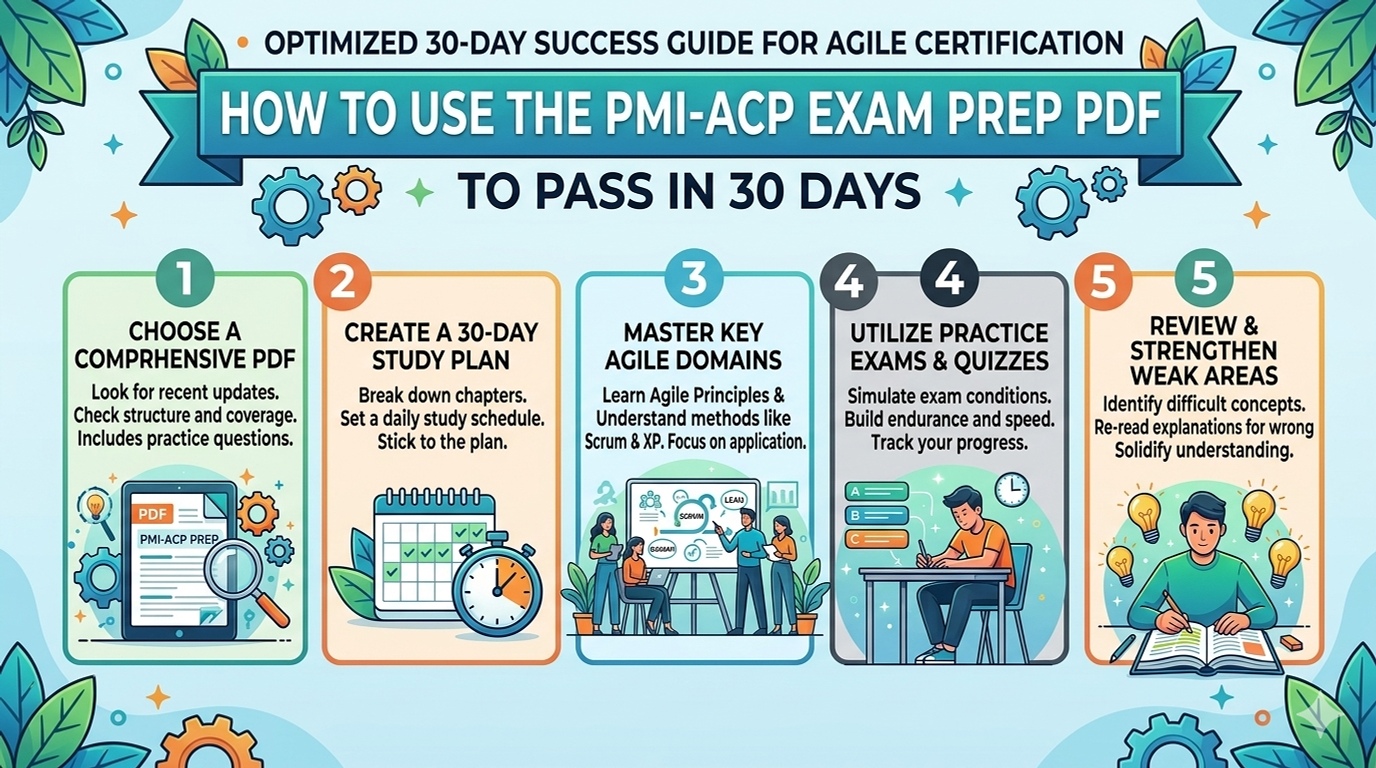
I divided the month into four distinct phases. Not weeks — phases. The distinction matters because some phases take longer than others, and forcing rigid weekly buckets made me anxious in a very unproductive way.
- Days 1–5 Orient & Map : Read the PDF cover to cover. No notes yet. Just absorb.
- Days 6–15: Deep Study : Domain by domain, annotate and cross-reference your prep book.
- Days 16–25: Practice Exams : Minimum 120 questions per day. Review every wrong answer.
- Days 26–30: Consolidate : Review weak domains only. Light reading. Rest.
Week 1: The “What Did I Get Myself Into?” Phase
The first time I opened the PDF, I didn’t try to memorize anything. That would've been a disaster.
Instead, I skimmed.
I read like someone flipping through a menu at Tim Hortons—just trying to see what’s there before ordering. No stress, no deep focus.
Here’s what I focused on:
- Understanding the structure of Agile (Scrum, Kanban, Lean… all the usual suspects)
- Getting familiar with terminology (even if I didn’t fully “get it” yet)
- Not panicking when I saw something confusing
By day five, you should be able to close the PDF and list the seven domains from memory. That's it. That's the whole goal for phase one.
Week 2: Things Start Clicking (Finally)
This is where the magic began.
I went back to the PDF—but slower this time. Much slower.
I started connecting ideas:
- Why Agile values individuals over processes
- How servant leadership actually works in real scenarios
- When to use which framework (and when not to)
I also did something simple but powerful—I talked out loud.
Yeah, I sounded a bit crazy. But explaining concepts like I was teaching someone else helped everything stick.
A few tricks that worked:
- Turning bullet points into mini-stories
- Relating concepts to real work situations
- Writing messy notes (not pretty, just useful)
Field noteI kept a separate notebook — just one — with a page per domain. Every confusion, every cross-reference, every "wait, how does this relate to that?" went in there. By exam day it had become my personal cheat sheet that I'd built entirely myself. That's not a coincidence. It's the point.
Week 3: Practice, Fail, Repeat
Here's what nobody tells you about PMI-ACP practice questions: the score doesn't matter. What matters is the review.
This was the tough week.
I started testing myself—and let’s just say… it wasn’t pretty at first. But here’s the thing nobody tells you: failing practice questions is part of the process. Every wrong answer became a clue.
I did 120–150 questions per day during this phase. Not because I'm some kind of masochist, but because the PMI-ACP questions are scenario-based. Long, detailed scenarios describing a team conflict or a stakeholder situation — and then asking what an agile practitioner should do. You need repetition to start seeing the patterns in how PMI frames correct answers.
My review process was strict:
- Every wrong answer: find the corresponding section in the prep PDF and read it again
- Every correct answer I wasn't sure about: same treatment
- Track wrong answers by domain — you'll see one or two patterns emerge fast
- Don't redo questions you already got right. That's a confidence trap.
"By day 20, I wasn't studying Agile. I was thinking in Agile. There's a difference — and the exam knows which one you're doing."
Week 4: The Final Stretch (Coffee Helps)
By now, the PDF felt familiar. Not easy—but familiar.
This week was all about tightening things up.
I didn’t try to learn new concepts. I focused on:
- Reviewing weak areas
- Re-reading tricky sections
- Doing timed practice tests
Do one light set of 60 questions on day 28, review it, and then close the books on day 29.
At one point, I remember studying during a cold evening, wrapped in a hoodie, thinking, “This better be worth it.” (If you’ve ever survived a Canadian winter, you know that kind of determination hits different.)
What Actually Made the Difference
Looking back, it wasn’t just the PDF itself—it was how I used it.
Here’s what truly helped:
- Consistency over intensity
I studied every day, even if it was just 30 minutes. I used 50-minute blocks with a 10-minute break. No exceptions. Not "just five more minutes." Not "I'm on a roll." When the timer went off, I wrote one sentence summarizing what I just covered, and I stopped. - One resource, not ten
No jumping between materials. Less confusion, more clarity. - Understanding > memorizing
Agile isn’t about definitions—it’s about thinking differently. - Learning from mistakes
Every wrong answer pushed me forward.
The Moment It Paid Off
Exam day came. I was nervous—but not lost.
And when I saw the questions… something clicked.
Not all of them, of course. But enough.
Because I didn’t just study the PDF.
I understood it.
What I'd Tell Someone Starting Tomorrow
Get the PMI-ACP Exam Prep PDF before you buy anything else.
Read it before you watch a single YouTube video. Let it structure your understanding before other resources fill in the details.
Then build your system around its domains, not around a prep course's module structure. The exam doesn't care about a vendor's curriculum. It cares about the ECO.
You've got 30 days. That's actually enough. I know it doesn't feel that way right now.
But the discipline isn't in grinding endlessly — it's in having a clear plan and following it even when you're not sure it's working.
It'll work. Now go make the coffee and open the PDF.
Some days will feel productive. Others… not so much.
That’s normal.
Just keep going.
Because one day, you’ll close that PDF, walk into the exam, and think:
“Okay… I’ve got this.”