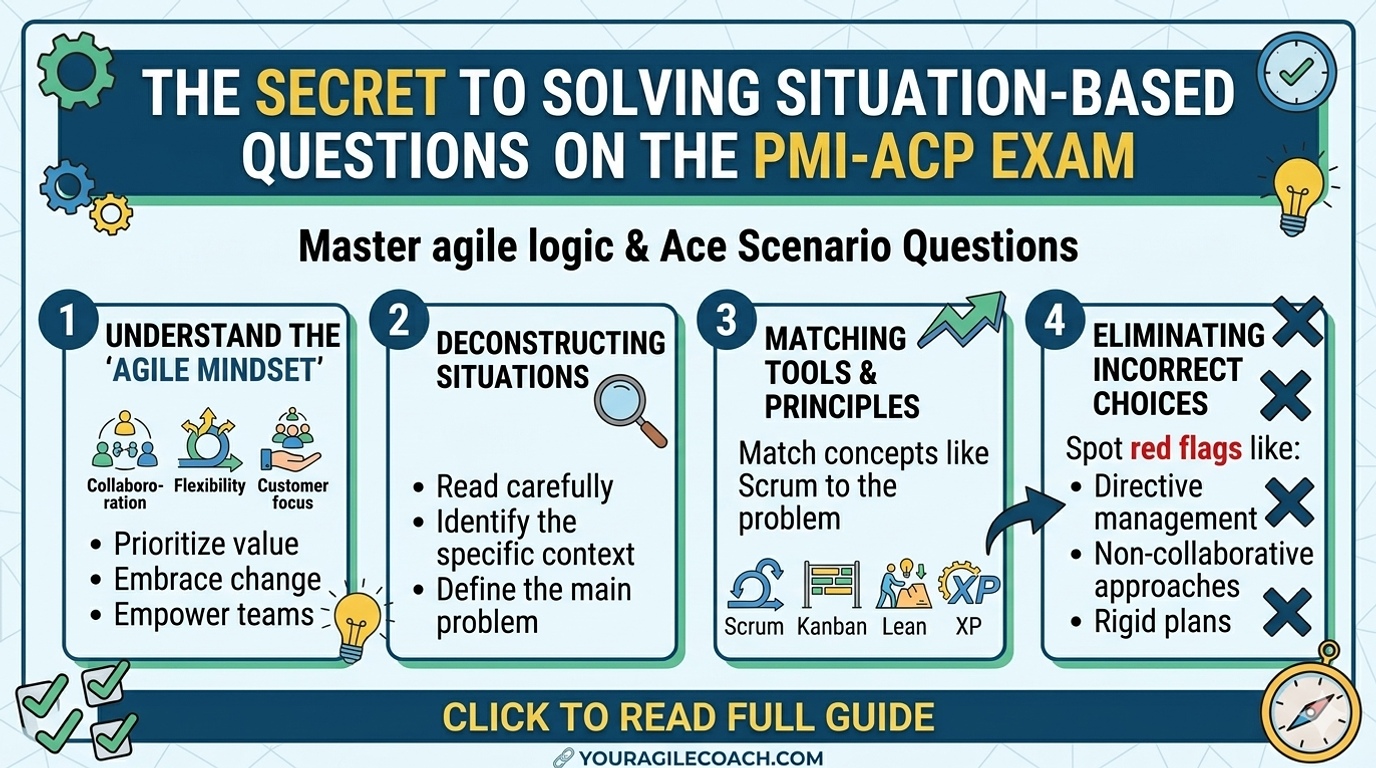
The Secret to Solving Situation-Based Questions on the PMI-ACP Exam
If you’re aiming for the PMI-ACP credential, you’ll quickly notice that many questions aren’t about memorizing facts. They’re about applying agile thinking to real-world situations. This guide breaks down a simple, beginner-friendly approach to tackle situation-based questions with confidence.
Why these questions feel tricky
Situation-based questions describe a project moment—like a sprint, a backlog, or a stakeholder conflict. Your job is to pick the option that aligns with agile values, principles, and practical behavior in the moment. The best answers show collaboration, adaptiveness, and a focus on delivering value.
A practical, easy-to-remember strategy
Use this four-step method whenever you face a scenario:
- — identify the goal and the current constraint.
- 2. Map to agile values — how would you honor individuals and interactions, customer collaboration, and responding to change?
- 3. Eliminate the obviously wrong — cross out options that violate basic agile principles (e.g., over-planning, ignoring feedback, or skipping collaboration).
- 4. Choose the best fit — pick the option that promotes teamwork, transparency, iterative delivery, and value to the customer.
Key principles to keep in mind
- Emphasize the agile manifesto: individuals and interactions over processes, working solutions over excessive documentation, customer collaboration, and responding to change.
- Think in terms of value delivery in short cycles (iterations/sprints).
- Remember common practices like daily stand-ups, backlog refinement, and transparent communication.
- Prioritize stakeholder feedback and adapting plans based on evidence.
Step-by-step example (simplified)
Scenario: A team is halfway through a sprint. A key stakeholder requests a change that would derail the current sprint goal. What should you do?
- Assess impact: Will the change threaten the sprint goal or can it wait until the next sprint?
- Consult with the team: Is the change feasible without breaking commitments?
- Offer a value-focused option: If possible, add the change as a low-risk backlog item for the next sprint.
- Communicate transparently: Inform stakeholders about trade-offs and next steps.
In this simplified flow, you’re aligning with agile values—collaboration, adaptability, and delivering value without derailing progress.
Common traps to avoid
- Ignoring feedback from the team or stakeholders.
- Overemphasizing a single plan over collaboration and learning.
- Choosing options that promise perfection but delay real value delivery.
- Misreading the role of the Scrum Master, Product Owner, or team context.
Practice tips that actually work
- Practice with real scenario questions daily to build pattern recognition.
- Write down why each option is right or wrong in simple terms.
- Use flashcards for agile principles and common exam traps.
- Simulate timed practice to improve pace without sacrificing accuracy.
- Review explanations or community discussions for diverse viewpoints.
Recommended resource to accelerate your prep
Want a focused study companion that puts these ideas into practice? Check out this practical guide in PDF format. It’s designed for quick reading, memorable takeaways, and exam-ready strategies.
Download the PMI-ACP Exam Prep PDF here: PMI-ACP Exam Prep (PDF).
As you study, remember: consistency is more powerful than marshaling all the theory at once. A little daily practice on situation-based questions will compound into real confidence on exam day. Stay curious, stay practical, and stay agile.