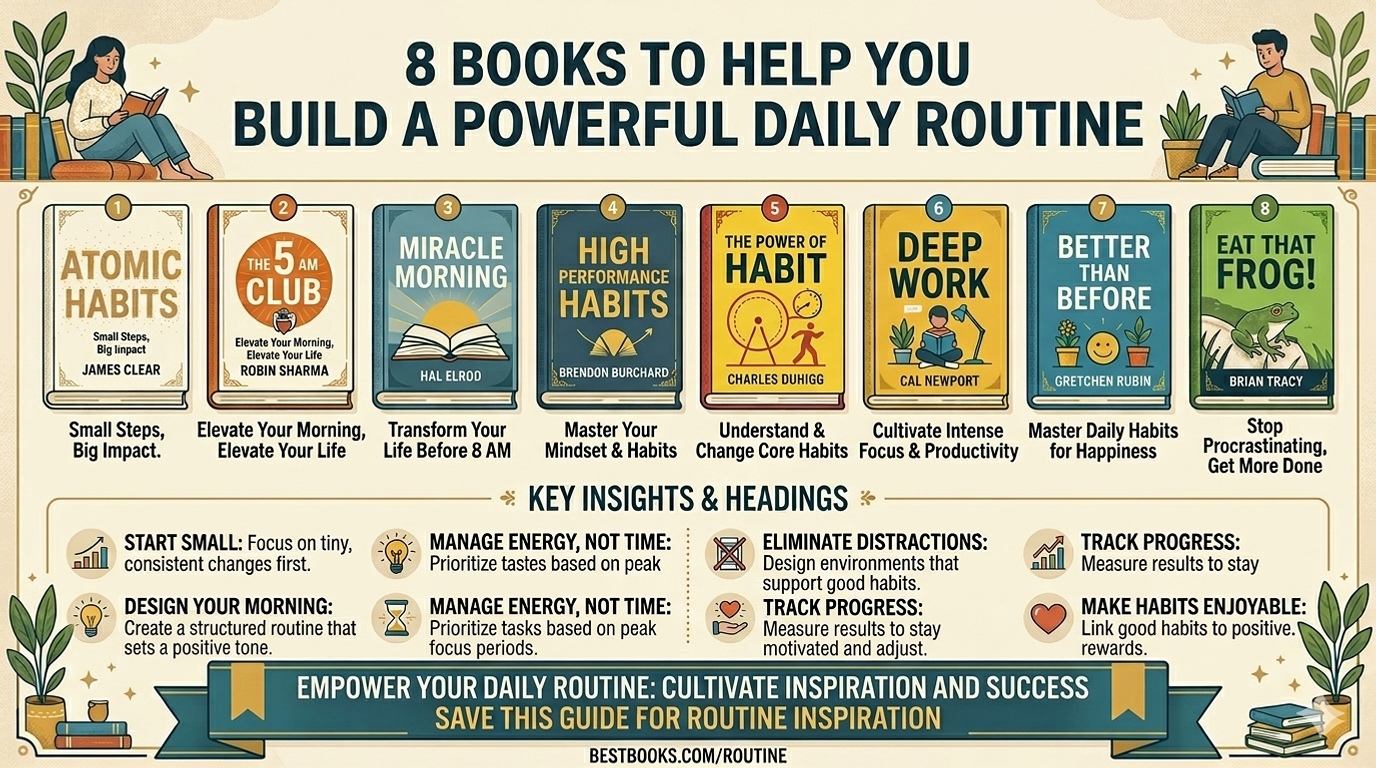
Looking to build a powerful daily routine? This beginner-friendly guide rounds up 8 top books that help you create sustainable habits, boost productivity, and design a winning morning routine. Whether you want more focus, better time management, or healthier daily rituals, these reads offer actionable steps, simple practices, and practical templates you can start today.
8 Books to Help You Build a Powerful Daily Routine
The 5 AM Club
To jump-start your mornings and lock in a steady routine, download the ebook here: The 5 AM Club.
- Why it helps your daily routine: waking early creates uninterrupted time for planning, exercise, and reflection.
- Core ideas you can apply: the 20/20/20 morning method (20 minutes movement, 20 minutes learning, 20 minutes reflection) – adaptable to most schedules.
- Action steps: set a fixed wake time, prep the night before, and build a simple, repeatable morning ritual.
Atomic Habits
A practical, easy-to-read guide on how tiny changes compound into big results—perfect for beginners exploring habit-building and daily routines.
- Key concepts: habit stacking, environment design, identity-based habits.
- How to use for your routine: replace a morning habit you don’t like with a tiny, easy-to-start action.
- Action steps: choose one tiny habit, cue it to an existing routine, and celebrate small wins.
Deep Work
Focus is the fuel for an effective daily routine. Deep Work teaches you to protect time for high-quality tasks and minimize distractions.
- Core ideas: deep work vs. shallow work, time-blocking, and distraction reduction.
- In your routine: schedule blocks of focused work before email and social media.
- Action steps: create a distraction-free workspace, set daily goals, and use timeboxing.
The Power of Habit
Understand the habit loop—cue, routine, reward—and learn how to redesign it for sustainable daily habits and routines.
- Key ideas: craving, routine, reward; loop reconstruction.
- For routine-building: identify triggers that start unhelpful mornings and replace the routine gradually.
- Action steps: map your morning habit loop and test small adjustments each week.
Make Your Bed
Short, practical, and surprisingly motivating for creating early-morning momentum and a sense of order.
- Takeaways: small wins matter; starting your day with a completed bed builds discipline.
- Routine impact: establishes a positive daily rhythm and reduces clutter-related stress.
- Action steps: add one simple morning ritual after waking up each day.
The Miracle Morning
Hal Elrod’s framework blends Silence, Affirmations, Visualization, Exercise, Reading, and Scribing to energize your mornings.
- Core components: S.A.V.R.S. (plus optional journaling).
- Routine fit: a 20–60 minute morning window works for most people.
- Action steps: pick 4 components, commit for 30 days, and track progress.
Getting Things Done
GTD offers a proven system to manage tasks, emails, and projects—reducing cognitive load and supporting a calmer daily routine.
- Core idea: capture, clarify, organize, reflect, engage.
- Routine angle: use GTD to structure daily planning and weekly reviews.
- Action steps: capture everything, define next actions, and perform a weekly review.
The One Thing
Focus on what matters most. This book teaches you to simplify your day and protect time for your most impactful task.
- Key idea: ask the focusing question: "What’s the one thing I can do such that by doing it everything else will be easier or unnecessary?"
- Routine benefit: reduces decision fatigue and speeds progress.
- Action steps: identify your daily top priority and guard that time block.
Tip: mix insights from multiple books to tailor a daily routine that’s truly yours. Start small, stay consistent, and adjust as you learn what works for you.